Your first African safari should be simple to plan and hard to forget. You want lots of wildlife, good guides, and travel days that don't wear you out. This guide ranks six places that do all three well. Each one is a destination Global Basecamps already builds trips around, so you can turn the list into a real plan.
Start early. The best tented camps and luxury lodges keep their bed counts small, and many fill 12 to 18 months ahead. If 2027 is your year, now is a good time to pick a region.
At a Glance: The 6 Best Safari Destinations for First-Timers
- Masai Mara National Reserve (Kenya): Best for big cats and Great Migration river crossings.
- Serengeti and Ngorongoro Crater (Tanzania): Best for classic plains scenery and a full Big Five checklist.
- Sabi Sands and the Private Reserves Bordering Kruger (South Africa): Best for leopard sightings and uncrowded, guided game drives.
- Chobe and the Okavango Delta (Botswana): Best for elephants, water safaris, and quiet camps.
- Etosha National Park (Namibia): Best for waterhole viewing and photography.
- Hwange National Park and Victoria Falls (Zimbabwe): Best for pairing a safari with a world wonder.
How We Ranked These Safari Destinations
We scored each destination on six criteria that matter most on a first trip:
- Wildlife density: How likely you are to see the Big Five (lion, leopard, elephant, rhino, and buffalo) in three or four days.
- Ease of access: How simple the flights and transfers are from a major hub like Nairobi, Johannesburg, or Cape Town.
- Guiding quality: Whether you can count on trained guides who read animal behavior and keep you safe.
- Lodging range: How many good options there are, from simple tented camps to luxury lodges.
- Seasonal reliability: How good the game viewing is outside the single best month.
- Activity variety: Whether you can mix game drives with walking safaris, boats, or cultural visits.
Details reflect published information as of 2026. Camps and routes change, so confirm specifics before you book. To see how these regions fit together, browse the Global Basecamps African safari tours.
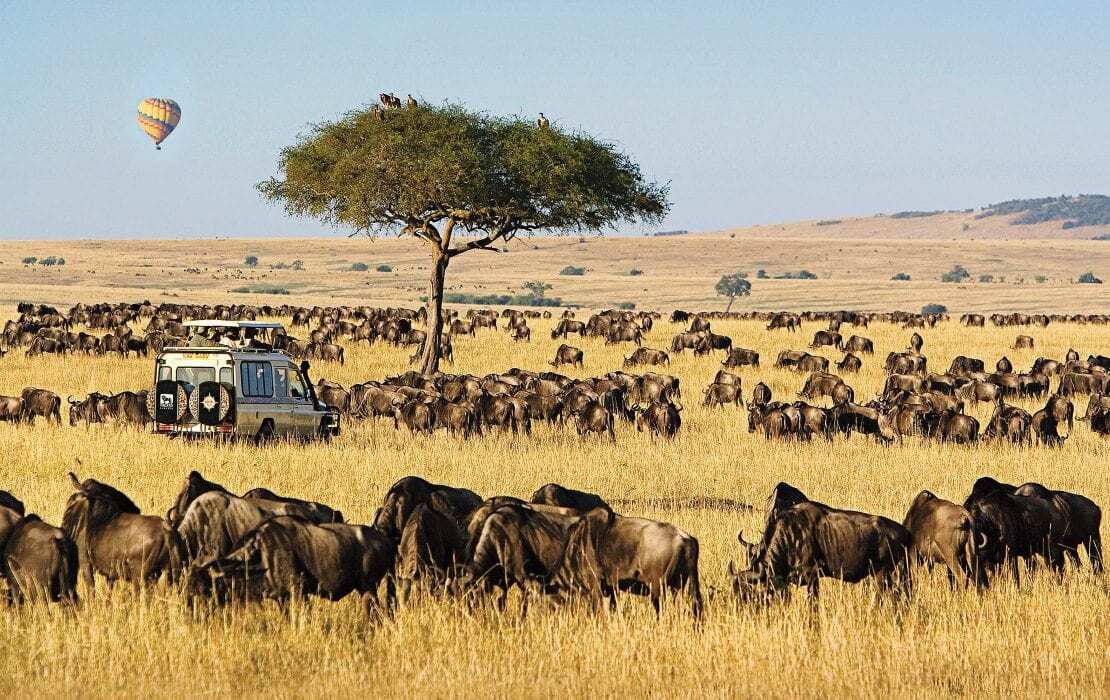
A hot-air balloon drifts over the Masai Mara as a safari vehicle sits among huge herds of grazing wildebeest, with a lone acacia tree rising above the golden grasslands.
1. Masai Mara National Reserve (Kenya)
What it specializes in: The Masai Mara specializes in big cat sightings and the drama of the Great Migration.
The Mara sits in southwestern Kenya and borders the Serengeti. From July to October, huge herds of wildebeest and zebra cross the Mara River while crocodiles wait in the water. Lions, cheetahs, and leopards are seen often, even outside migration months.
Sentinel Mara Camp is a good example of a first-timer base. It is a seasonal tented camp on the banks of the Mara River in the Musiara Marsh area, with no permanent structures. Guests can watch hippos and crocodiles from the lounge tent. A hot-air balloon flight over the reserve is an optional extra.
Global Basecamps uses Sentinel Mara Camp on its 9-day Best of Kenya itinerary. That trip starts in Nairobi, spends three nights near Lake Naivasha with visits to Lake Nakuru and Hell's Gate, moves to Samburu, and ends with three nights in the Mara.
- Location: Southwestern Kenya, a short flight from Wilson Airport in Nairobi.
- Style: Tented camps and lodges with guided game drives.
- Best Time to Visit: July to October for river crossings. Game viewing stays strong the rest of the year.
- Best For: Travelers who want big cat action and a classic East Africa first trip.
- How It Compares: The Maasai Mara is smaller than the Serengeti, so animals are packed closer and drives are shorter. It also gets busier at crossing points in peak season. Private conservancies on the reserve's edge limit vehicles and allow walks and night drives. If crowds worry you, the northern Serengeti (entry 2) sees the same crossings with fewer cars.
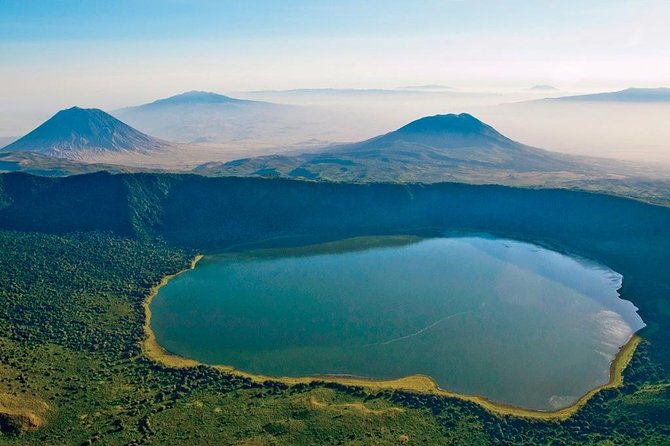
An aerial view of a deep blue crater lake ringed by forested walls in Tanzania's Ngorongoro highlands, with volcanic peaks rising on the horizon.
2. Serengeti National Park and Ngorongoro Crater (Tanzania)
What it specializes in: The Serengeti specializes in endless plains and the largest remaining unaltered animal migration in the world.
The Serengeti National Park covers about 14,760 square kilometers (roughly 5,700 square miles) in northern Tanzania. It became a UNESCO World Heritage Site in 1981. More than a million wildebeest move through it each year with zebras and gazelles, and lions, hyenas, and cheetahs follow close behind.
Nearby, the Ngorongoro Conservation Area protects what UNESCO calls the largest unbroken caldera in the world. You drive down to the crater floor for a full day of game viewing. It is one of the best places in Tanzania to see the endangered black rhino.
The 10-day Northern Circuit Wildlife Migration Safari from Global Basecamps links it all. It starts in Arusha, spends two nights at Tarangire Ndovu Tented Lodge in Tarangire, visits Esilalei Maasai Village, and descends into Ngorongoro Crater. It then spends two nights at Naona Moru Camp in the central Serengeti and two at Kaskaz Mara Camp, a 10-tent camp near the Mara River in the north.
- Location: Northern Tanzania, reached through Kilimanjaro International Airport near Arusha.
- Style: Road safari between parks, with tented camps and lodges.
- Best Time to Visit: June to October for the northern migration. Early in the year, herds gather on the southern plains for calving season.
- Best For: First-timers who want the iconic Tanzania safari and a shot at all of the Big Five.
- How It Compares: A Tanzania safari covers more ground than the Mara and offers more variety, from Tarangire's elephants to the crater. You spend more time in the vehicle, though. Many travelers end with a few beach days in Zanzibar, which the Mara can't match.
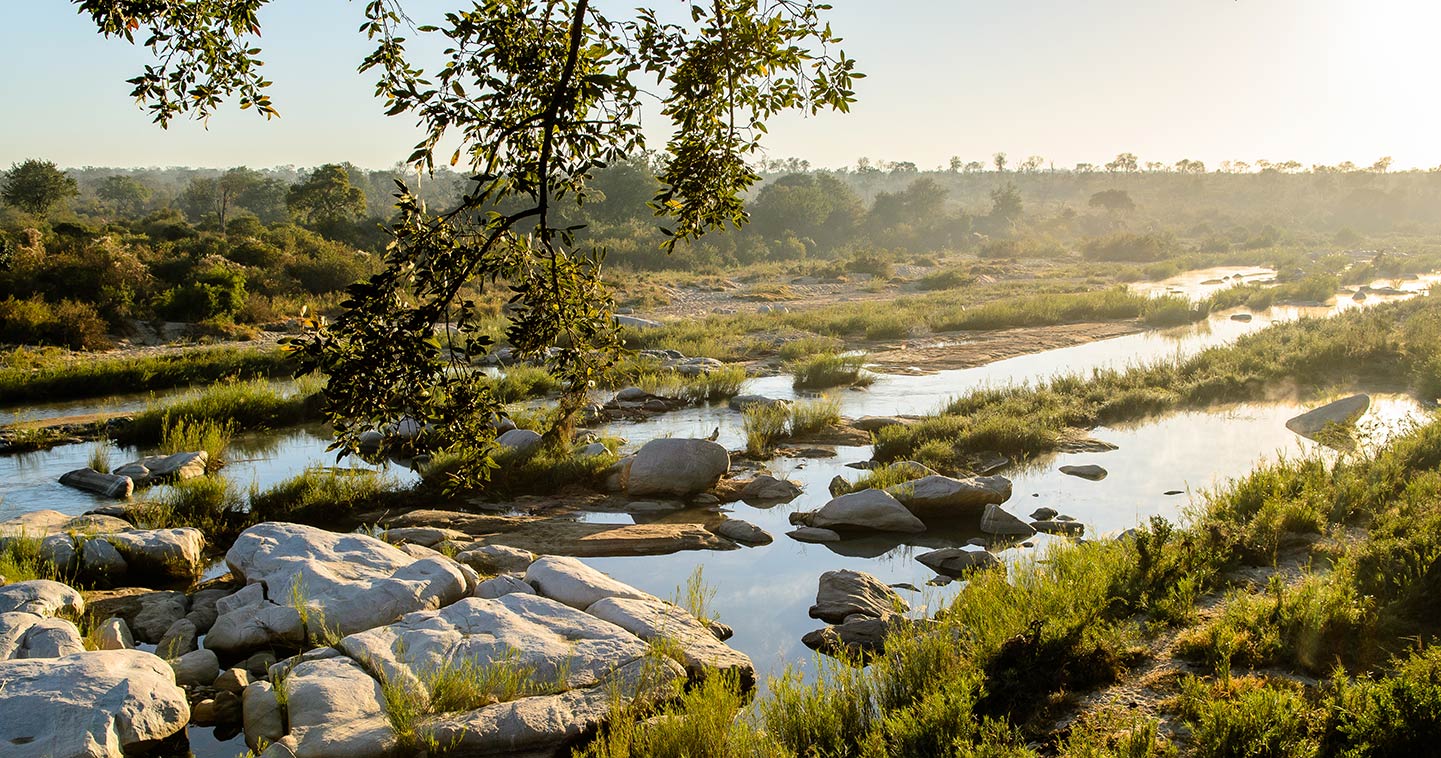
Morning light filters through the trees over a shallow river winding between smooth boulders and green reeds in the bush near South Africa's Kruger National Park.
3. Sabi Sands and the Private Reserves Bordering Kruger (South Africa)
What it specializes in: The private reserves bordering Kruger specialize in uncrowded game viewing and some of the most reliable leopard sightings in Africa.
Kruger National Park was established in 1926 and is home to all of the Big Five. The main park is very busy, with crowded roads, lots of vehicles at each sighting, and many self-drivers, so Global Basecamps doesn't place clients there. Instead, it uses the private concessions that border Kruger, like Sabi Sands and Timbavati. There are no fences between these reserves and the park, so wildlife moves freely across, but vehicle numbers are limited and guides can track animals off-road.
Nottens Bush Camp sits in the northeast corner of the Sabi Sands Game Reserve. It uses candles and oil lamps instead of electric lights in the evening. Each day includes early-morning and evening game drives in an open Land Rover and a midday bush walk.
Global Basecamps uses Nottens Bush Camp on its 10-day South Africa Heritage Explorer. The trip spends two nights in Johannesburg with a Soweto tour, four nights in Cape Town, and three nights in the bush, with flights into Skukuza.
- Location: Northeastern South Africa, with flights into Skukuza and nearby airports.
- Style: Private reserve lodges with guided game drives and bush walks.
- Best Time to Visit: The dry winter months, when thinner bush makes animals easier to spot.
- Best For: Travelers who want short transfers, strong infrastructure, and a city stop in Cape Town.
- How It Compares: The private reserves around Kruger are the easiest entry point in Southern Africa, with short transfers and far fewer vehicles than the main park. Sabi Sands is the best known, and Timbavati is a quieter alternative. The Kruger area is in a malaria zone, so families who want a malaria-free option often look at Madikwe instead.
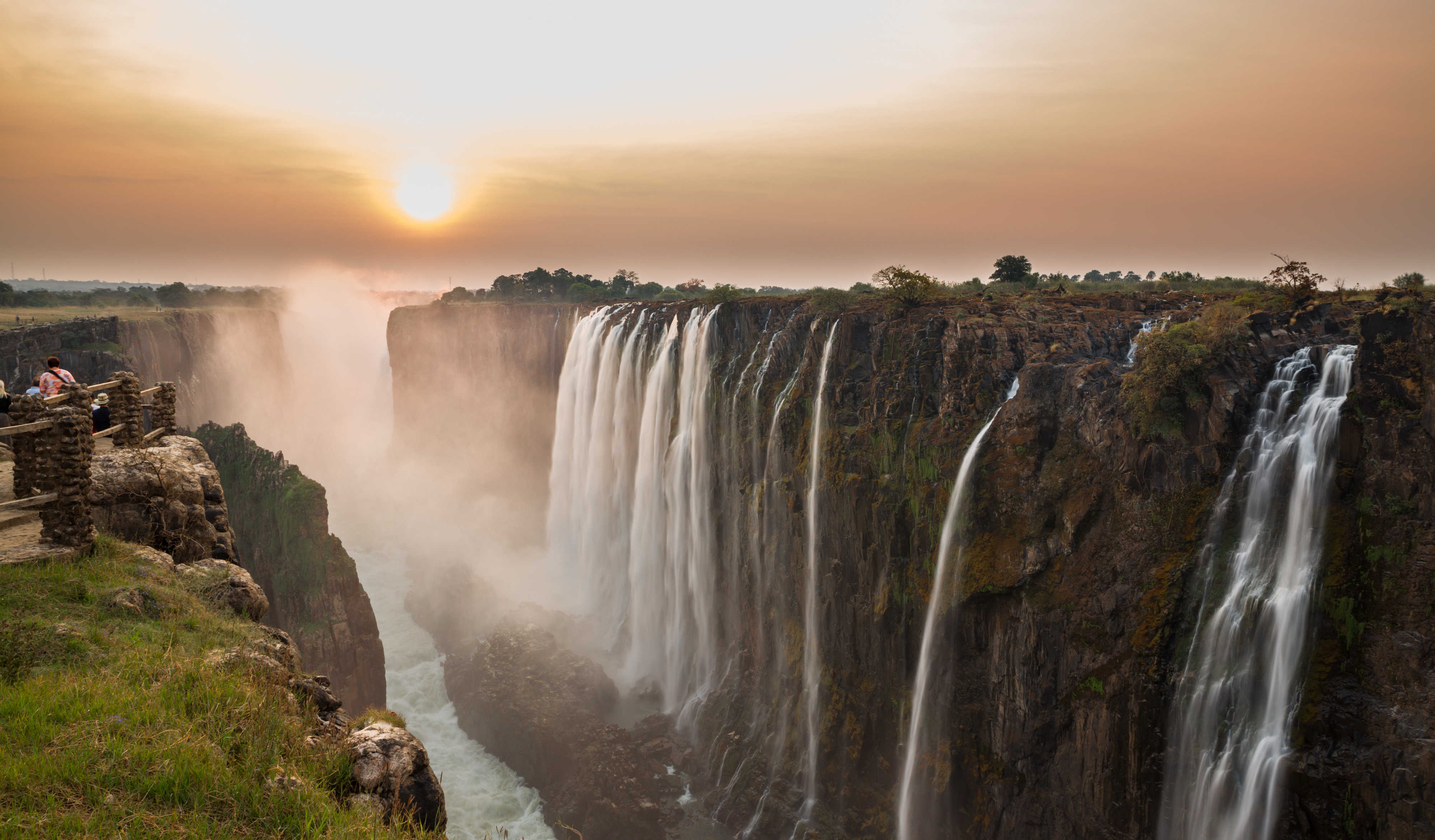
The sun sets over Victoria Falls as mist rises from the gorge and visitors take in the view from a rocky ledge beside the falling water.
4. Chobe National Park and the Okavango Delta (Botswana)
What it specializes in: Botswana specializes in elephants, water safaris, and remote camps with few other vehicles.
Botswana has the world's largest elephant population, about 130,000, according to UNESCO. In Chobe's Savuti area, Ghoha Hills Savuti Lodge sits on a hillside with tents on raised decks that look over a waterhole. Full-day drives here reach the Savuti Marsh and the Savuti Channel.
The Okavango Delta became a World Heritage Site in 2014. Its flood peaks around June and July, during the dry season, which pulls in wildlife when water is scarce elsewhere. You explore by mokoro (a dugout canoe), on foot with an armed guide, and by vehicle.
The Northern Highlights itinerary from Global Basecamps covers this region in 11 days. It starts with two nights at Victoria Falls Safari Lodge, then flies to Ghoha Hills Savuti Lodge, Machaba Camp in the Khwai Concession, and Sanctuary Stanley's Camp in the delta.
- Location: Northern Botswana, with flights out of Kasane and Maun.
- Style: Fly-in tented camps and lodges, linked by light aircraft.
- Best Time to Visit: The dry season, when the delta floods and animals gather near water.
- Best For: Couples and anyone who wants quiet, water-based game viewing.
- How It Compares: Botswana costs more than South Africa's private reserves, but you share sightings with far fewer vehicles. The Chobe Riverfront near Kasane is known for boat trips past elephant herds. Khwai allows night drives and walks, which the main Moremi Game Reserve does not.
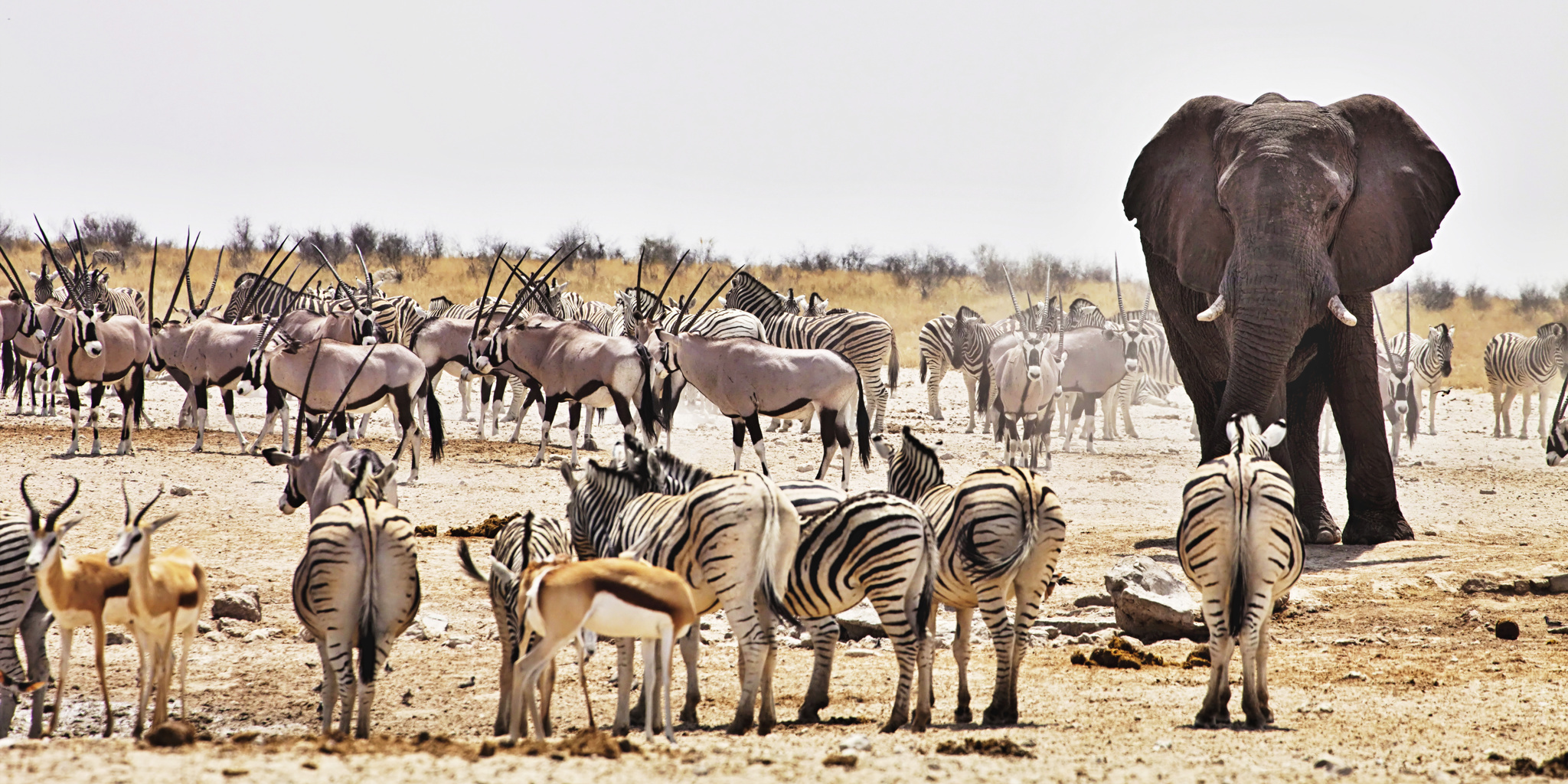
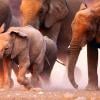
An elephant, zebras, oryx and springbok gather at a waterhole on the dusty plains of Etosha National Park in Namibia.
5. Etosha National Park (Namibia)
What it specializes in: Etosha specializes in waterhole viewing, where the wildlife comes to you.
Etosha means "Great White Place." A huge mineral pan fills the center of the park and holds water only briefly after heavy rain. Springs along its edges draw large herds of animals and birds, including flamingos when the pan floods.
Okaukuejo Camp sits at the western end of the pan and was Etosha's first tourist camp. Its main draw is a floodlit waterhole you can watch from camp at night. Elephants, lions, and black rhino visit often. The camp is run by Namibia Wildlife Resorts, and it is best explored on a guided tour.
Global Basecamps includes two nights at Okaukuejo on its 9-day Best of Namibia Safari Adventure. The trip also flies to Sossusvlei for the dunes, spends two nights at Camp Kipwe in Damaraland looking for desert-adapted wildlife, and ends at Okonjima Bush Camp, home to the AfriCat Foundation.
- Location: Northern Namibia, a few hours' drive or a short flight from Windhoek.
- Style: Rest camps and lodges, explored on an escorted, guided tour.
- Best Time to Visit: The dry season, when wildlife crowds around the waterholes.
- Best For: Photographers and travelers who like big open landscapes.
- How It Compares: Etosha has fewer big cats than the Mara, but its waterholes make sightings easy to predict. Namibia is one of the few places in Africa where self-drive works well, but an escorted, guided tour is still the better way to see it. Its desert scenery feels very different from the green plains of East Africa.
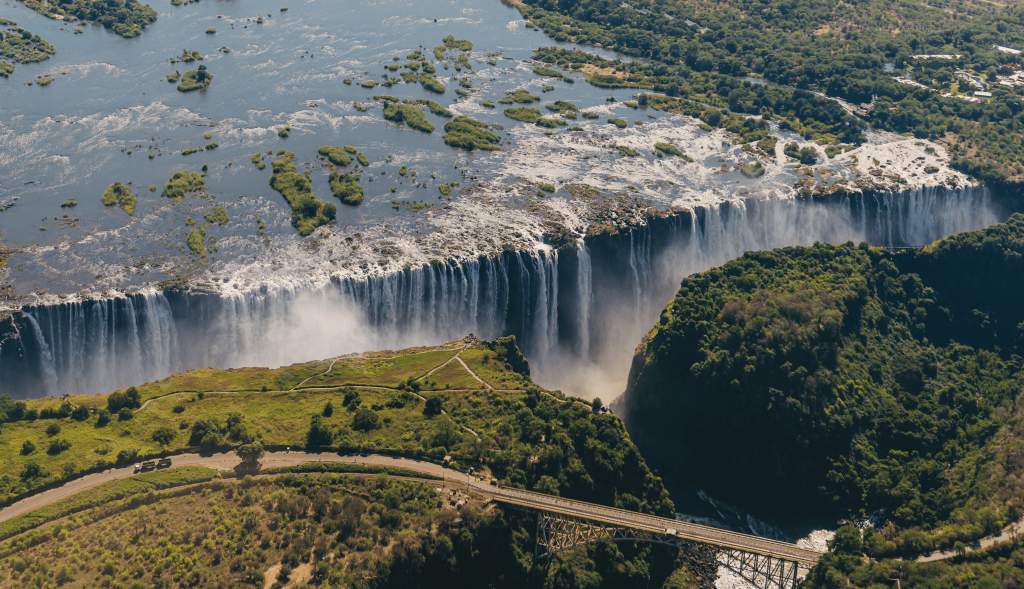
An aerial view of Victoria Falls plunging into its deep gorge, with the Zambezi River and its green islands above and the Victoria Falls Bridge spanning the canyon below.
6. Hwange National Park and Victoria Falls (Zimbabwe)
What it specializes in: Zimbabwe specializes in pairing a big game park with one of the world's great waterfalls.
Hwange National Park is the largest natural reserve in Zimbabwe, at about 14,650 square kilometers. Park staff pump water into many of its pans, so elephants and other large animals gather there in the dry season.
Camelthorn Lodge has eight forest villas in a private concession on the park's southeastern edge. It has a sunken hide, built from a shipping container set into the ground, that looks out over a waterhole. Guests can also try walking safaris, night drives, and horse riding on the Ngamo Plains.
Mosi-oa-Tunya / Victoria Falls spans about 1,708 meters on the border of Zimbabwe and Zambia. On the Global Basecamps Best of South Africa and Zimbabwe itinerary, you spend four nights in Cape Town, three at Zambezi Sands River Camp about an hour from the falls, and three at Camelthorn Lodge. The transfer to Hwange includes a ride on the Elephant Express train.
- Location: Western Zimbabwe, with flights into Victoria Falls Airport.
- Style: Lodges and river camps, with game drives, walks, and canoeing.
- Best Time to Visit: The dry season for Hwange. The falls flow hardest after the rains.
- Best For: Travelers who want a safari plus a famous sight in one easy trip.
- How It Compares: Hwange sees fewer visitors than Kruger and has big elephant herds, but fewer luxury lodges. Zambia's South Luangwa is better known for walking safaris. Victoria Falls is also easy to add to a Botswana trip, as the Northern Highlights route in entry 4 shows.
Planning Tips for Your First African Safari
Pick Your Season First
The season shapes your whole trip. In the dry season, the bush thins out and there are fewer water sources, so wildlife gathers in much higher concentrations around the remaining waterholes and rivers. That makes animals easier to find and sightings more frequent. Mornings can be cold. In the green season, rates often drop, crowds thin, and baby animals arrive, but expect afternoon storms.
Choose Guided Drives Over Self-Drive
Global Basecamps never recommends self-driving in Kruger. Namibia is one of the few places where self-drive works well, but even there, an escorted, guided tour is the better choice, especially on a first trip. Guides read tracks and animal behavior, share sightings by radio, and keep you at a safe distance. Most of the trips in this guide include guided game drives.
Pack Light and Neutral
Small bush planes often limit bags to about 33 to 44 pounds in soft duffels, so check your exact limit. Pack khaki, tan, and olive layers. Skip dark blue and black, which attract tsetse flies in parts of East Africa. Bring binoculars for each traveler and a warm layer for dawn drives.
Add a Second Stop
Many first trips pair the bush with a city, beach, or primate trek. Cape Town fits well with Sabi Sands, Zanzibar with Tanzania, and Victoria Falls with Botswana or Hwange. For mountain gorillas, Uganda and Rwanda are the places to go gorilla trekking.
Frequently Asked Questions
What is the best country for a first African safari?
Kenya and Tanzania are the classic picks for wildlife numbers and the Great Migration. South Africa is the easiest for logistics. Botswana is best if you want fewer vehicles and can spend more.
How many days do I need for a first safari?
Plan on at least three to four nights in the bush. Many Global Basecamps safari itineraries run 9 to 11 days, which leaves room for two or three camps or a city stop.
When is the best time to see the Great Migration?
River crossings usually happen from July to October in the Masai Mara and the northern Serengeti. Calving happens on the southern Serengeti plains early in the year.
Can I see the Big Five on my first safari?
Yes, in the right place. The private reserves bordering Kruger and the Ngorongoro Crater give you strong odds of seeing all five, including rhino, in a short stay.
Is a safari safe for first-timers?
Yes, when you travel with trained guides and follow camp rules. Stay in the vehicle unless your guide says otherwise, and never walk alone at night in unfenced camps.
Can I add gorilla trekking to a safari?
Yes. Uganda and Rwanda are the main places to see mountain gorillas, and Global Basecamps offers a 21-day Beyond the Big Five trip that combines Uganda, Tanzania, and Zanzibar. Ask your trip planner how a trek fits your dates.
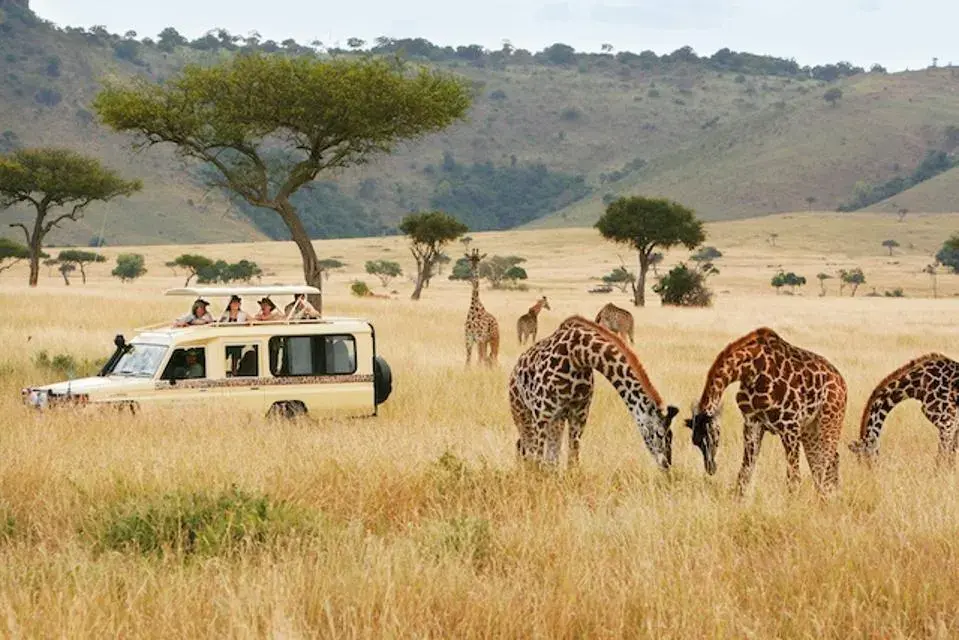
A safari vehicle pauses as a group of giraffes grazes in the tall golden grass, with acacia trees and rolling green hills behind them.
Ready to Plan Your First Safari?
Your first safari is about the right fit, not the longest list. Pick the region that matches your style, lock in your season, and book early for 2027. When you're ready, start planning your trip with Global Basecamps and a specialist will help you shape the route.