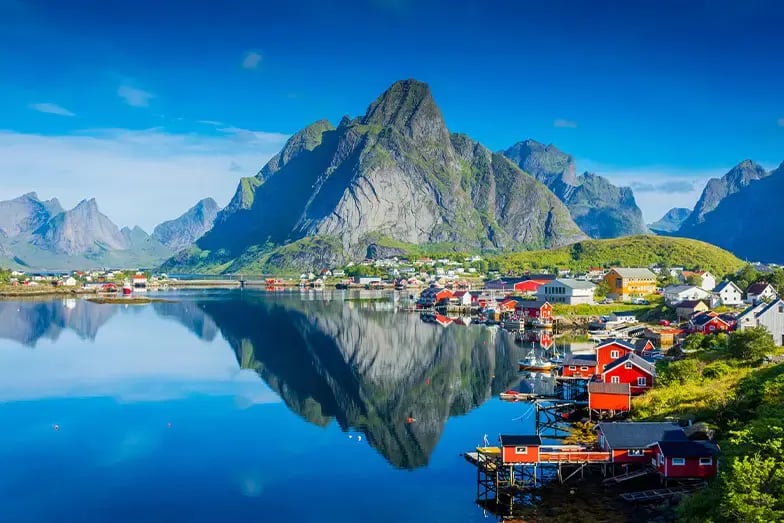
There are hundreds of fjords in Norway, and no one can see them all on one trip. The good news? You don't need to. A handful of fjords give you the steep walls, tumbling waterfalls, and quiet villages most people picture when they dream about the Norwegian coast.
We've picked seven fjords and ranked them by what they're best for, how easy they are to reach, and how they fit into a real trip. You'll find the classic fjords near Bergen and Flåm, the big names in the northwest, and a few quieter gems farther north.
At a Glance
- Nærøyfjord: Best for narrow, dramatic UNESCO scenery on a fjord cruise
- Aurlandsfjord: Best for rail fans and the Stegastein viewpoint
- Sognefjord and Fjærlandsfjord: Best for glaciers and Norway's longest fjord
- Geirangerfjord: Best for famous waterfalls and postcard views
- Romsdalsfjord: Best for mountain rail, gondolas, and big cliffs
- Trollfjord: Best for sea eagles and Arctic scenery in Lofoten
- Oslofjord: Best for adding fjord time to a city stay
How We Ranked These Fjords
Here's what we looked at for each fjord:
- Scenery and scale: How dramatic the walls, waterfalls, and views are.
- Access: How easy it is to reach by train, ferry, bus, or car.
- On the water: The quality of the fjord cruise, ferry, or boat safari options.
- On land: Hiking, viewpoints, villages, and culture near the shore.
- Crowd levels: How busy it feels in peak season.
- Trip fit: How well it works inside a multi-day Norway itinerary.
Details reflect published information as of 2026. Schedules and seasonal openings can change, so it's worth confirming before you book. Curious how these fjords fit into a full route? Browse our Norway tours.
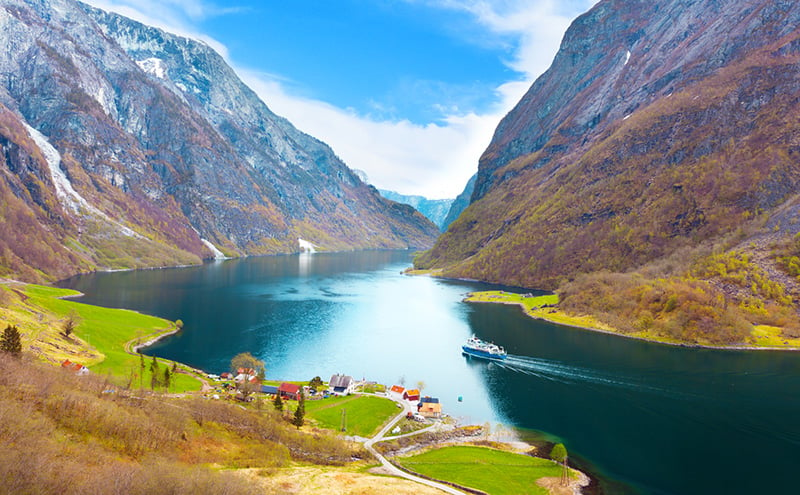
Steep, rust-colored mountainsides close in around the narrow waters of Nærøyfjord, part of the West Norwegian Fjords UNESCO World Heritage Site.
1. Nærøyfjord (Sognefjord, Western Norway)
What it specializes in: Nærøyfjord specializes in tight, steep, and quiet fjord scenery that you see best from the water.
Nærøyfjord is a narrow arm of the Sognefjord, and it's every bit as dramatic as the photos. It's part of the West Norwegian Fjords UNESCO World Heritage Site, listed in 2005 together with Geirangerfjord. The walls rise almost straight out of the water, and tiny farms and boathouses cling to the shore.
Most travelers see it from the boat between Flåm and Gudvangen. On Global Basecamps' Norway Discovery itinerary, that's a relaxing two-hour cruise along the Aurlandsfjord and Nærøyfjord. At Gudvangen, you can stop by Njardarheimr, a Viking village in Viking Valley, before a bus to Voss and the train to Bergen. Take a look at the full Norway Discovery itinerary to see how the days connect.
Here's a nice bonus: Norway has set zero-emission rules for its World Heritage fjords, starting with ships under 10,000 gross tons in 2026 and covering larger ships from 2032.
- Location: Between Flåm and Gudvangen, Vestland
- Style: Fjord cruise, kayaking, Viking culture
- Best Time to Visit: May to September for long days; winter for snow and few crowds
- Best For: First-time visitors who want the classic narrow fjord
- How It Compares: Nærøyfjord feels wilder and more closed in than Geirangerfjord, with fewer big ships. It is the fjord leg of the popular Norway in a Nutshell route, so it's easy to pair with the Flåm Railway. Hardangerfjord is wider and greener, while Nærøyfjord is all rock and water.
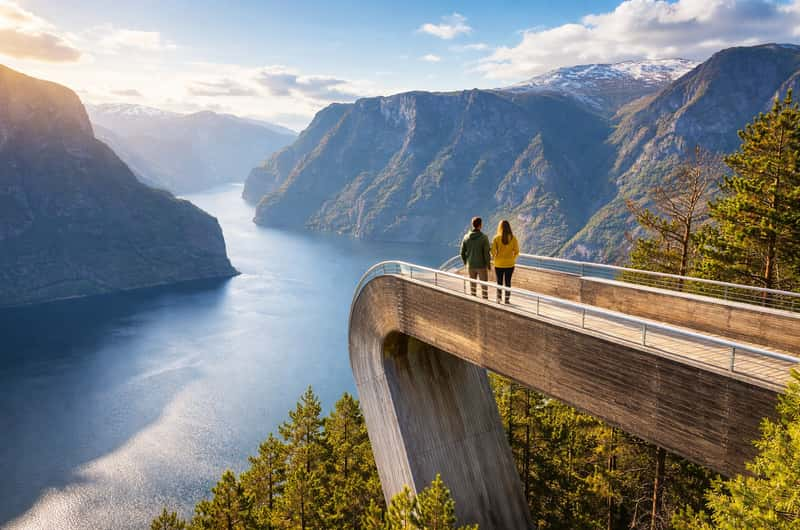
Travelers take in the view from the Stegastein viewpoint, which juts out 650 m above the Aurlandsfjord.
2. Aurlandsfjord (Flåm and Aurland)
What it specializes in: Aurlandsfjord specializes in easy access, great viewpoints, and the famous Flåm Railway.
Flåm sits at the head of the Aurlandsfjord, and getting there is half the fun. The Flåm Railway (Flåmsbana) runs about 20 km from Myrdal down to the fjord. It drops more than 860 m and winds through 20 tunnels in under an hour. Global Basecamps' Norway Discovery itinerary takes the Bergen Railway from Oslo to Myrdal, then rides the Flåm Railway down for three nights at the Flåmsbrygga Hotel.
High above the fjord, the Stegastein viewpoint juts 30 m out from the mountainside, 650 m above the water. You'll find it on the road from Aurland to Lærdal. On the Norway Discovery itinerary, a winter snowshoe hike starts right at Stegastein, and other days bring a floating fjord sauna and dinner at Ægir BrewPub in Flåm.
Across the water, the little village of Undredal is home to a stave church from the 1100s. With just 40 seats, it's often called the smallest stave church still in use in Scandinavia.
- Location: Flåm, Aurland, and Undredal, Vestland
- Style: Scenic rail, viewpoints, food and culture
- Best Time to Visit: Year round; winter adds snowshoeing and quiet trains
- Best For: Travelers without a car and rail lovers
- How It Compares: Aurlandsfjord is the busiest hub in the Sognefjord area because of the railway. It has better transit links than Geirangerfjord or Lysefjord. Stegastein gives a view similar to Flydalsjuvet above Geiranger, but you can reach it by bus.
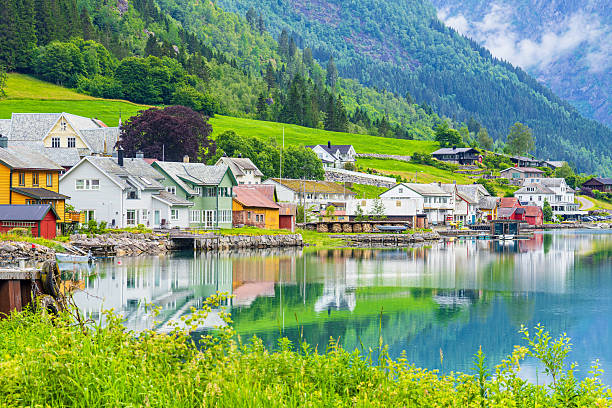
Colorful wooden houses line the calm shore at Fjærland, the village at the head of the Fjærlandsfjord.
3. Sognefjord and Fjærlandsfjord (Balestrand)
What it specializes in: The Sognefjord specializes in sheer size, and the Fjærlandsfjord adds glaciers to the trip.
The Sognefjord is Norway's longest fjord, and it's big in every sense. It runs more than 200 km inland and reaches 1,308 m deep, which is why many call it the "King of the Fjords." Nærøyfjord, Aurlandsfjord, and Fjærlandsfjord are all branches of it.
Balestrand sits right in the middle of the fjord. On Global Basecamps' Norway Uncovered itinerary, you'll take the Norled express boat from Bergen and spend two nights at the Kviknes Hotel, a Swiss-style hotel the Kvikne family has run since 1877. A guided day trip cruises the Fjærlandsfjord to the Norwegian Glacier Museum and the Bøyabreen glacier. Bøyabreen is an arm of Jostedalsbreen, the largest glacier in continental Europe.
History fans, don't miss the Urnes Stave Church, a UNESCO site on the Sognefjord built in the 12th and 13th centuries.
- Location: Balestrand and Fjærland, Vestland
- Style: Express boats, glacier views, historic hotels
- Best Time to Visit: Late spring to early autumn, when boat routes run most often
- Best For: Travelers who want fjords and glaciers on the same day
- How It Compares: The Sognefjord is wider and calmer than Nærøyfjord. For glaciers, it competes with Olden on the Nordfjord, where Briksdalsbreen also flows from Jostedalsbreen. Balestrand is quieter than Flåm and has a more old-world feel.

Flower boxes line the harbor boardwalk in Geiranger, the small village at the head of the Geirangerfjord.
4. Geirangerfjord (Sunnmøre)
What it specializes in: Geirangerfjord specializes in famous waterfalls, abandoned cliff farms, and classic postcard views.
Geirangerfjord is about 15 km long and shares its UNESCO listing with Nærøyfjord. Mountains over 1,600 m rise all around it. Look for the Seven Sisters waterfall, which faces the Suitor across the fjord, and the Bridal Veil nearby.
High on the cliffs, you'll spot old farms like Skageflå and Knivsflå. You can hike up to Skageflå, and boat trips stop below the others. The Geiranger to Hellesylt car ferry runs the length of the fjord, so it doubles as a sightseeing trip and a road link.
Geiranger isn't on a current Global Basecamps itinerary, but it's easy to work in. Norway Uncovered spends three nights in Ålesund, the usual base for Geiranger day trips, and a specialist can help you add one.
- Location: Geiranger and Hellesylt, Møre og Romsdal
- Style: Car ferry, fjord safari, cliff hikes, road trips
- Best Time to Visit: Late spring for peak waterfalls; summer for open mountain roads
- Best For: Travelers who want the most famous fjord views
- How It Compares: Geirangerfjord is busier than Nærøyfjord, but its waterfalls are bigger. It pairs well with Trollstigen and Ålesund. If you want quiet, Romsdalsfjord or Balestrand will feel calmer.

The Romsdalen Gondola climbs from Åndalsnes up to Nesaksla, with the Romsdal valley spread out below.
5. Romsdalsfjord (Åndalsnes)
What it specializes in: Romsdalsfjord specializes in mountain scenery you can reach by train and gondola.
Åndalsnes sits at the end of the Romsdalsfjord, tucked below the Romsdal Alps. Global Basecamps' Norway Uncovered itinerary gets you there on the Rauma Railway, a 114 km line from Dombås. Along the way, the train crosses the Kylling Bridge, 60 m above the Rauma River, and passes Trollveggen, often called Europe's highest vertical rock wall.
The Romsdalen Gondola starts just a few steps from the train station. In about four and a half minutes, you're up at Eggen Restaurant on Nesaksla, with sweeping views over the fjord and peaks. The next day, a bus follows the Romsdalsfjord to Ålesund, the art nouveau town that is the gateway to the fjords of Sunnmøre.
- Location: Åndalsnes, Møre og Romsdal
- Style: Scenic rail, gondola, hiking
- Best Time to Visit: Late May to September, when Trollstigen is open
- Best For: Hikers and train fans who want fewer crowds
- How It Compares: Romsdalsfjord is less famous than Geirangerfjord, but the Rauma Railway rivals the Flåm Railway. Trollstigen, with its 11 hairpin turns, is about 18 km away. The Romsdalseggen ridge hike competes with Trolltunga and Preikestolen for big views.
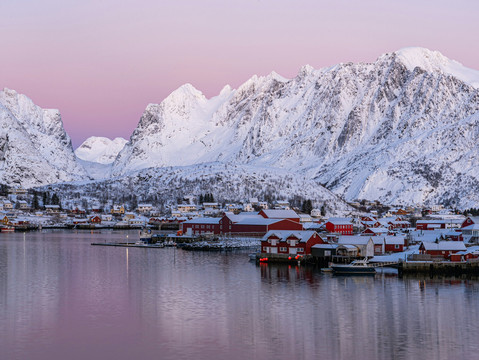
Snowy peaks rise above red fishermen's cabins in Lofoten, the island chain that is home to Trollfjord.
6. Trollfjord (Lofoten and Vesterålen)
What it specializes in: Trollfjord specializes in Arctic wildlife and a dramatic, hard-to-reach fjord.
Trollfjord is small but mighty. It's only about 2 km long, and its mouth is about 100 m wide. You can reach it only by boat or by a rough hike, and Hurtigruten ships on the Bergen to Kirkenes route often detour inside for a look.
On Global Basecamps' Norway Uncovered itinerary, you'll sail Hurtigruten from Trondheim to Svolvær and stay at Svinøya Rorbuer, a cozy set of fishermen's cabins. From Svolvær, a sea eagle safari runs through the Raftsundet strait and into Trollfjord. Local operators run the two-hour RIB trip year round.
- Location: Near Svolvær, Nordland
- Style: Boat safaris, wildlife, coastal cruising
- Best Time to Visit: Summer for the midnight sun; winter for the northern lights
- Best For: Wildlife lovers and travelers heading north to Tromsø
- How It Compares: Trollfjord is tiny next to the Sognefjord, but it feels just as dramatic. Unlike the western fjords, it pairs well with Arctic stops like Senja and Tromsø. It has far fewer visitors than Geirangerfjord.

A cruise ship sails through turquoise water between steep green cliffs in the western fjords.
7. Oslofjord (Oslo)
What it specializes in: Oslofjord specializes in easy fjord time without leaving the capital.
Fun fact: Oslofjord isn't a true fjord in the geological sense, but Norwegians call it one anyway. It's dotted with hundreds of islands, and Hovedøya, close to the city, has old monastery ruins to explore.
Global Basecamps' Norway, Finland and Sweden Odyssey includes a group fjord sightseeing boat from Oslo. You'll pass Hovedøya, the Dyna Lighthouse, the Opera House, and the Bygdøy peninsula, home to the Fram Museum and the Norwegian Maritime Museum.
- Location: Oslo and the inner Oslofjord
- Style: City sightseeing boats, islands, museums
- Best Time to Visit: Summer for island hopping; winter for a calm city break
- Best For: Short trips and travelers starting in Oslo
- How It Compares: Oslofjord has gentle shores, not sheer cliffs like Nærøyfjord or Lysefjord. Think of it as a warm-up before the western fjords, not a swap for them.
Planning Your Norway Fjord Trip
Start in Bergen, the Gateway to the Fjords
Bergen is the easiest base for the western fjords. Boats leave for Balestrand, and trains run to Voss and Myrdal. Save some time for Bryggen, the UNESCO-listed Hanseatic wharf. Both Norway Discovery and Norway Uncovered spend nights in Bergen.
Pick Your Way of Getting Around
The good news is that trains, express boats, and buses cover most of the fjords on this list. Norway in a Nutshell is a popular self-guided version of the Oslo, Flåm, and Bergen route. If you'd like more freedom for Geiranger, Trollstigen, and Lofoten, a car is the way to go. And a Hurtigruten coastal cruise links Bergen to the far north.
What About Hardangerfjord and Lysefjord?
Hardangerfjord is known for its fruit orchards, Vøringsfossen waterfall, the Folgefonna glacier, and the Trolltunga hike. Lysefjord, near Stavanger, is home to Preikestolen (Pulpit Rock) and Kjerag. Both are wonderful, but neither is on a current Global Basecamps route. Just ask a specialist if you'd like to add one.
Head North for the Northern Lights
Northern Norway pairs fjords with Arctic culture, and it's magical in winter. Tromsø makes a great base for northern lights trips. Farther south along the coast, the Vega Archipelago is a UNESCO site just south of the Arctic Circle, known for its eider duck tradition.
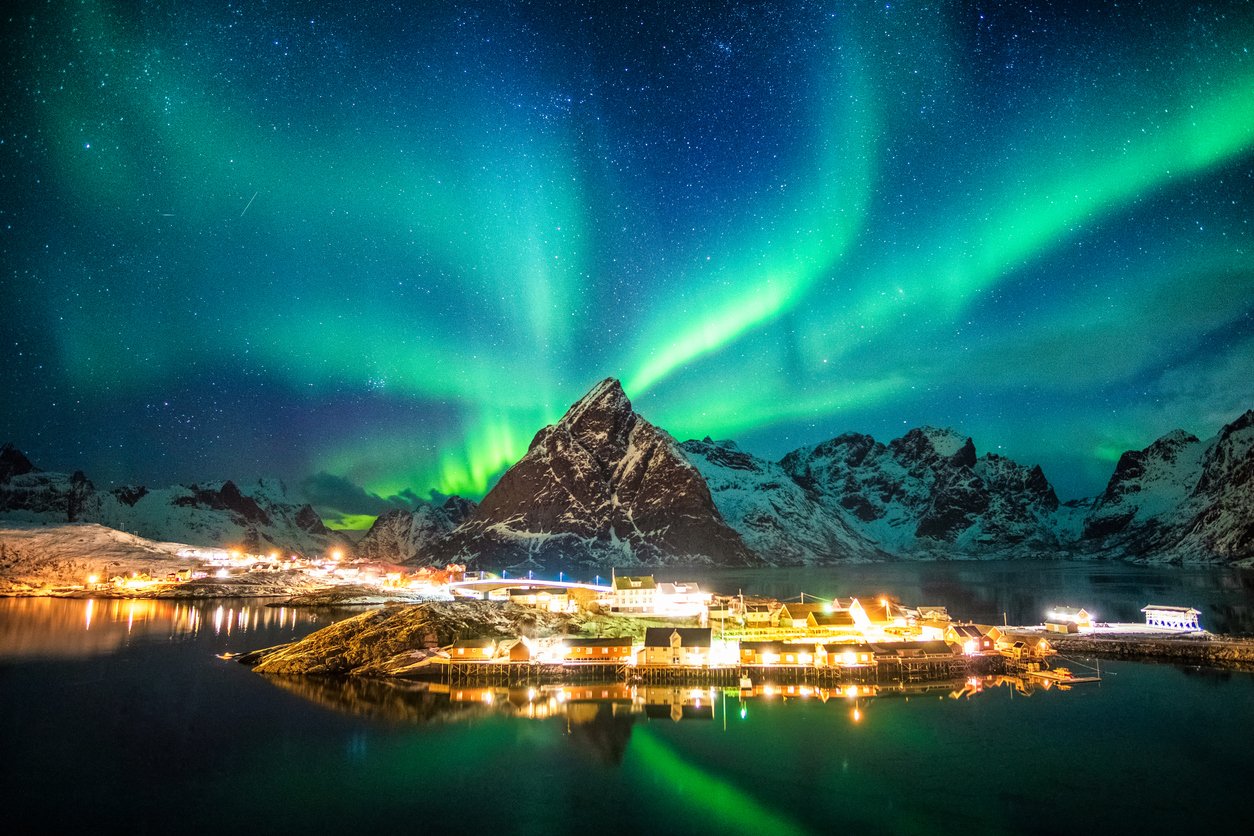
The northern lights swirl above a snowy Lofoten fishing village on a clear winter night.
FAQ: Which Fjords to See in Norway
Which fjord in Norway is best for first-time visitors?
Nærøyfjord and Aurlandsfjord are the easiest pair to start with. In one day, you can ride the Flåm Railway, cruise to Gudvangen, and continue on to Bergen.
What is Norway's longest fjord?
That would be the Sognefjord. It runs more than 200 km inland from the coast, which is how it earned the nickname "King of the Fjords."
Is Geirangerfjord or Nærøyfjord better?
It depends on what you're after. Geirangerfjord has bigger waterfalls and more famous views. Nærøyfjord is narrower, quieter, and easier to reach by train and boat. Both are UNESCO listed, so you really can't go wrong.
Can you see the fjords without a car?
Absolutely. Trains, express boats, and buses connect Oslo, Flåm, Gudvangen, Balestrand, Åndalsnes, and Bergen.
When is the best time to visit the fjords in Norway?
May to September brings long days and open mountain roads. Winter is quieter and adds snow activities, though some roads close for the season.
Can you see fjords and the northern lights on one trip?
Yes, and it's a wonderful combination. Pair the western fjords with a winter stay in Tromsø or Lofoten, where Trollfjord is close by.
How many days do you need to see the fjords?
Plan on at least a week so you can enjoy it without rushing. Norway Discovery covers Oslo, Flåm, and Bergen in 8 days, while Norway Uncovered spends more than three weeks along the coast.
Plan Your Norway Fjord Trip
The best fjord trips mix one or two famous fjords with a quieter one and leave room for slow days. Our specialists would love to build a custom route around the fjords you care about most. Whenever you're ready, start planning your Norway trip with us.