Cambodia is a land that refuses to be defined by a single era. For some, it is the mystical silhouette of Angkor Wat reflected in a lotus pond at dawn. For others, it is the chaotic, high-energy hum of a Phnom Penh street market or the scent of Kampot pepper wafting from a seaside crab shack. It is a country that has endured unimaginable hardship and emerged with a spirit that is as warm as its tropical climate.
If you are planning your first trip, you aren't just visiting a country; you are stepping into a living history book where ancient stone gods watch over a modern nation finding its stride. This guide is your roadmap to navigating that beautiful complexity, ensuring your first foray into the Kingdom of Wonder is nothing short of transformative.
Why Cambodia Belongs at the Top of Your Bucket List
Most travelers arrive in Cambodia to check a "New Seven Wonder of the World" off their list, but they stay because of the people. The Khmer people possess a resilience and hospitality that is genuinely humbling. Unlike some neighbors in Southeast Asia where tourism can feel transactional, Cambodia often feels personal.
Beyond the warmth of the locals, Cambodia offers an incredible "bang for your buck." You can dine like royalty on a backpacker’s budget, explore world-class archaeological sites, and retreat to luxury island resorts that rival the Maldives - all within a few hours of each other. It is a place where you can find deep spiritual stillness in a 12th-century forest temple and, by sunset, be sipping a cocktail in a sophisticated urban sky bar. It is this juxtaposition of the ancient and the aspirational that makes Cambodia an essential destination.
Ready to Experience Cambodia? Whether you're dreaming of Angkor Wat, floating villages, jungle adventures, or relaxing on a private island, Global Basecamps offers a variety of journeys designed to showcase the very best of Cambodia.
👉 Explore Cambodia with Global Basecamps
Essential Tips for Navigating Your First Visit
Before you pack your linen shirts and sturdy boots, you need to understand the rhythm of the country. Cambodia doesn't always follow the rules of the West, and knowing the "unwritten" logistics will save you hours of frustration.
When to Go: Timing Your Trip with the Monsoons
Cambodia is governed by the sky. The year is split into two main seasons: the Dry (November to April) and the Wet (May to October).
Most travelers flock to the country between November and February when the air is cool and the humidity is manageable. This is the "Goldilocks" zone for temple hopping. However, don't overlook the "Green Season" (the monsoon). While you will deal with afternoon downpours, the countryside explodes into a vibrant, neon green, the dust disappears, and the crowds at major sites thin out significantly. Plus, the temple moats are full, making for those iconic, glass-like reflections.
Visa Logistics and Entry Requirements
Cambodia has made great strides in digitizing its entry process. Most nationalities can apply for a T-class (tourist) e-visa online before arrival. It costs roughly $36 and saves you from the "visa-on-arrival" scramble at the airport.
A crucial tip: as of mid-2024, Cambodia introduced the e-Arrival Card. You should complete this online within seven days of your arrival to streamline the immigration and health declaration process. Always ensure your passport has at least six months of validity and a few blank pages; the Cambodian visa sticker is a beautiful, full-page affair.
Currency and Connectivity: Cash is King
Cambodia operates on a dual-currency system that can be confusing for the uninitiated. The US Dollar (USD) is used interchangeably with the Cambodian Riel (KHR). Generally, large purchases are quoted in dollars, while small change is given in Riel.
As of recently, the government has been pushing for more Riel usage, and many vendors no longer accept small, worn, or slightly torn USD bills. My advice? Carry pristine, crisp $10 and $20 bills for larger expenses, but rely on Riel for everything else. For connectivity, grab a local SIM card (Smart or Cellcard) at the airport. For less than $10, you’ll have more data than you could possibly use in a month, which is essential for using Grab or PassApp - the local ride-hailing apps that prevent you from having to haggle over every tuk-tuk ride.
Understanding the "Grand Circuit" vs. the "Small Circuit"
When you reach Siem Reap, you’ll hear these terms constantly. Think of them as the "Greatest Hits" playlists of the Angkor Archaeological Park.
The Small Circuit is the 17-kilometer loop that hits the heavy hitters: Angkor Wat, the ancient city of Angkor Thom with its Bayon face temple, and Ta Prohm (the Tomb Raider temple). The Grand Circuit is a longer, 26-kilometer loop that takes you to the outlying "suburban" temples like Preah Khan and Neak Poan. If you have three days, do the Small Circuit on day one, the Grand on day two, and use the third day to venture to the intricate carvings of Banteay Srei or the remote, jungle-choked ruins of Beng Mealea and Koh Ker, home to the seven-tiered Prasat Thom.
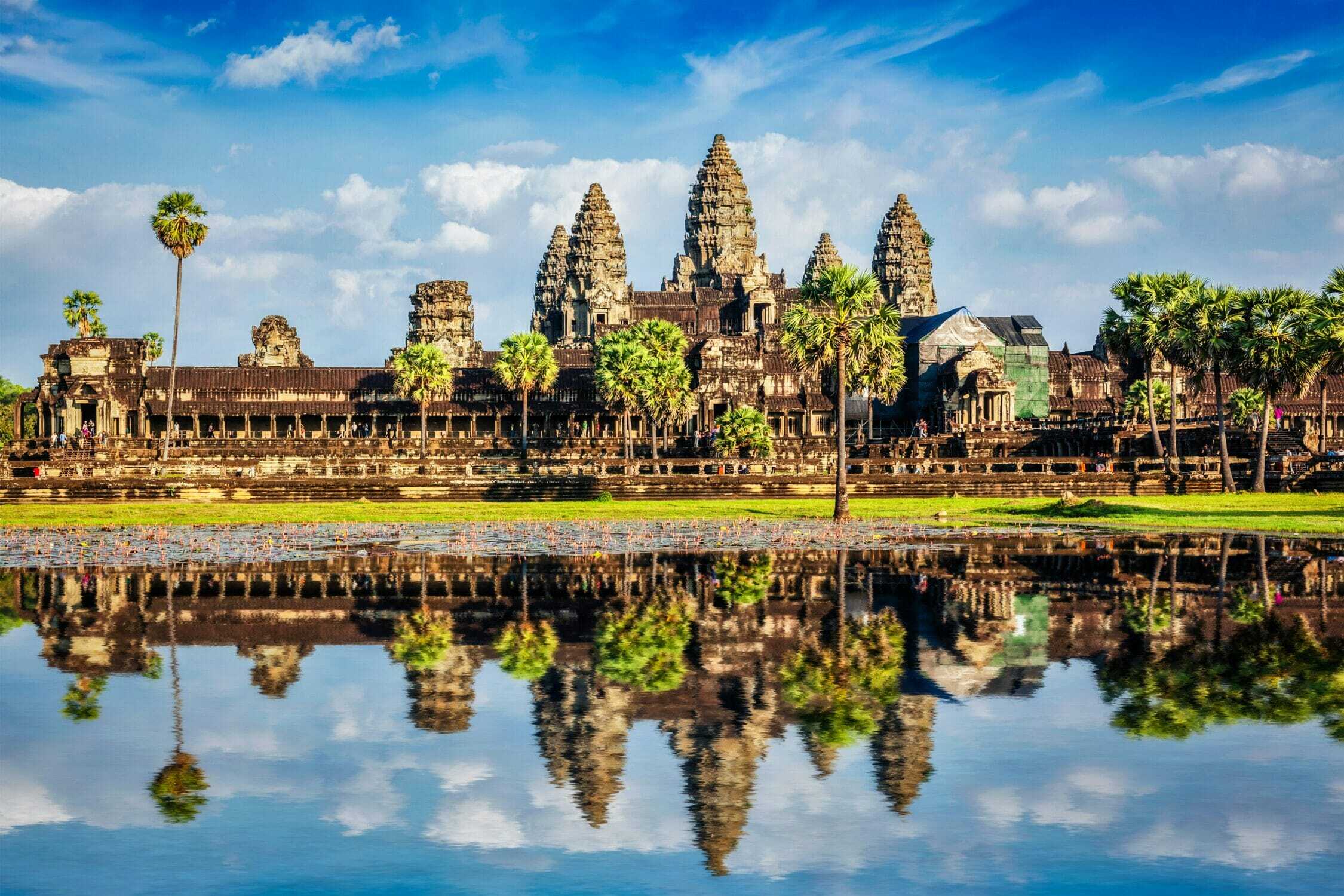
Angkor Wat’s ancient stone towers reflected in a calm pond, framed by palm trees under a bright blue Cambodian sky.
1. Siem Reap & Angkor Wat: The Gateway to the Kingdom of Angkor
Siem Reap was once a sleepy cluster of villages; today, it is a world-class tourism hub that manages to retain its charm. It serves as the base camp for the Angkor temples, but the city itself has a pulse that demands your attention.
Exploring the Angkor Archaeological Park
Angkor Wat is the largest religious monument in the world, and no matter how many photos you’ve seen of this temple complex, the scale is staggering. To truly appreciate it, hire a licensed guide. They aren't just there to point out statues; they translate the "stone libraries" carved into the walls, explaining the Hindu epics and Khmer history that the stones represent.
Pro tip: Everyone goes to Angkor Wat for sunrise. To avoid the worst of the crowds, consider starting your day at a "back gate" temple like Preah Khan at dawn, then visiting Angkor Wat in the late afternoon when the tour buses head back for lunch. The light hits the western face of the main temple perfectly just before sunset.
Beyond the Temples: Phare Circus and Artisans Angkor
Don't let "temple fatigue" set in. When you need a break from ruins, head to Phare, The Cambodian Circus. This isn't a circus with animals; it’s a high-energy blend of theater, acrobatics, and storytelling performed by students from a vocational arts school in Battambang. It is arguably the best evening entertainment in the country.
For a quieter afternoon, visit Artisans Angkor. This social enterprise trains young people from rural villages in traditional Khmer crafts like silk weaving, stone carving, and lacquering. You can watch the masters at work and buy high-quality souvenirs that directly support the local economy.
The Pub Street Experience and Night Markets
As the sun sets, the action shifts to Pub Street. It is loud, neon-lit, and unapologetically touristy - think $1 beers and "fried ice cream" stalls. While it’s a fun place to grab a drink and people-watch, the real magic lies in the surrounding alleys. Explore the Old Market (Phsar Chas) for a sensory overload of spices and textiles, or cross the river to the Made in Cambodia Market for more upscale, locally produced crafts and live music.
👉 Explore Siem Reap & Angkor Wat
.jpeg?width=710&height=473&name=images%20(1).jpeg)
A golden monument in Phnom Penh rising against a dramatic sunset sky as motorbikes pass along the road below.
2. Phnom Penh: A Study in Resilience and Contrast
Phnom Penh is a city of "and." It is beautiful and gritty; it is modernizing rapidly and deeply rooted in tradition. It is the heartbeat of Cambodia, and you cannot understand the country without spending time here.
Honoring the Past: The Killing Fields and Tuol Sleng
A visit to the Tuol Sleng Genocide Museum (S-21) and the Choeung Ek Genocidal Center (The Killing Fields) is a somber, non-negotiable part of any Cambodian itinerary. These sites document the atrocities of the Khmer Rouge regime in the 1970s.
It is a heavy experience, often leaving visitors in silent reflection. However, witnessing the scale of what the Cambodian people have overcome makes their current kindness and progress all the more remarkable. Use the audio guides; they are expertly produced and provide the necessary context to process the history with the respect it deserves.
The Royal Palace and National Museum
To see the "Golden Era" of Cambodia, head to the Royal Palace. The Silver Pagoda, with its floor made of five tons of shimmering silver tiles, is a testament to the country’s artistic heritage. Just a short walk away is the National Museum, a stunning example of Khmer architecture that houses the world’s finest collection of Khmer sculptures. It’s the perfect place to "meet" the gods and kings you saw carved into the stones at Angkor.
Riverside Sunsets and the Emerging Culinary Scene
As evening approaches, join the locals for a stroll along the Sisowath Quay (Riverside). The confluence of the Tonle Sap River and Mekong rivers creates a natural cooling breeze.
Phnom Penh’s food scene is currently exploding. From the high-end Khmer "fusion" at Malu to the legendary pork and rice (bai sach chrouk) served on plastic stools at street corners, your palate will never be bored. Don’t miss the chance to try a "Kampot Pepper Martini" at one of the city’s hidden speakeasies - the capital’s nightlife is surprisingly sophisticated.
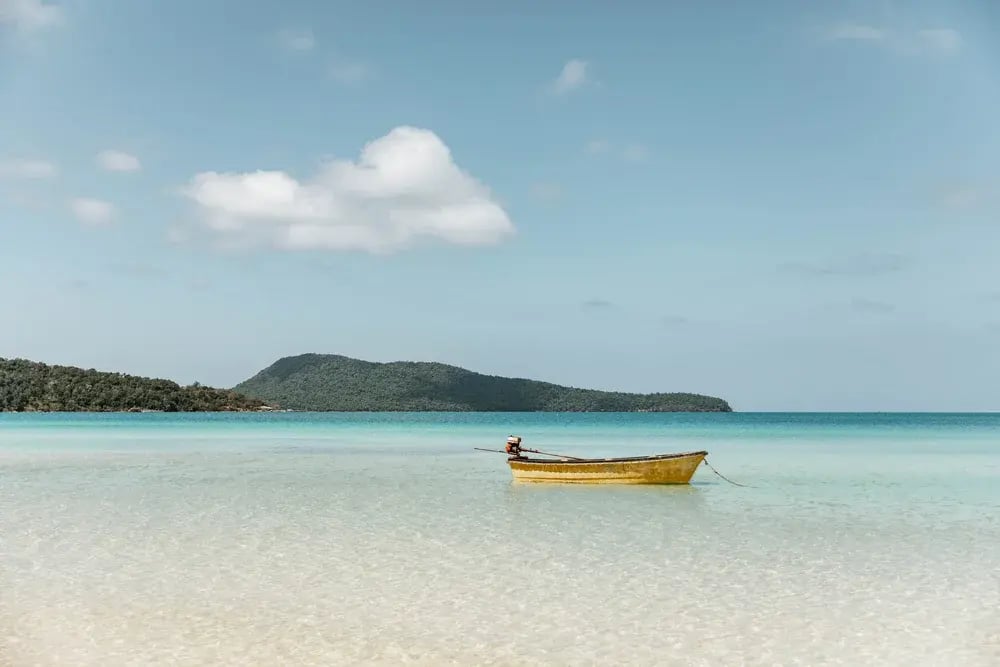
A wooden longtail boat floating in Koh Rong's shallow turquoise water.
3. Koh Rong & Koh Rong Samloem: Island Paradises
If you think you have to go to Thailand for white sand and turquoise water, Cambodia’s islands are about to surprise you. Located off the coast of Sihanoukville, these islands offer a tropical escape that feels significantly more "untouched."
Choosing Between Party Vibes and Total Seclusion
The two main islands have very different personalities. Koh Rong is the larger, more energetic sibling. The area of Koh Touch is the hub for backpackers, fire shows, and late-night beach parties. If you want social energy, this is your spot.
Koh Rong Samloem, on the other hand, is the place to go if you want to disappear. Saracen Bay features a long crescent of shallow, crystal-clear water and quiet boutique resorts. For the ultimate "off-the-grid" experience, hike across the island to Lazy Beach or Sunset Beach, where the electricity is limited, and the only soundtrack is the waves hitting the shore.
Snorkeling, Diving, and Bioluminescent Plankton
The waters around the islands are teeming with life. You can book a boat trip for a few dollars that includes snorkeling, fishing, and a BBQ on a secluded beach. But the real magic happens after dark. On nights with little moon, you can swim with bioluminescent plankton. As you move through the water, the tiny organisms light up like underwater stars. It is a surreal, bucket-list experience that no camera can quite capture.
The Reality of Island Infrastructure
A quick word of warning: island life in Cambodia is rustic. While luxury resorts are popping up, many guesthouses rely on generators, and Wi-Fi can be spotty at best. There are no ATMs on the islands, so bring plenty of cash from the mainland. Think of it as a forced digital detox - the kind we all probably need.
👉 Explore Koh Rong & Cambodia's Southern Islands
.jpeg?width=720&height=542&name=images%20(2).jpeg)
A waterfront view of Kampot's colorful colonial buildings and temples overlooking a river.
4. Kampot: Riverside Charm and Peppery Delights
Kampot is the place travelers go for two days and end up staying for two weeks. This riverside town is defined by its French colonial architecture, a slow pace of life, and a world-renowned agricultural product.
The World-Famous Kampot Pepper Plantations
Kampot Pepper is the first Cambodian product to receive "Geographical Indicator" status (like Champagne in France). The mineral-rich soil and sea breeze create a flavor profile that chefs around the world covet. Visit a plantation like La Plantation to learn how green, black, red, and white pepper are all harvested from the same vine. Tasting fresh green pepper fried with squid is a culinary rite of passage here.
Kayaking the "Green Cathedral"
The Prek Tuek Chhou river loops around Kampot, creating a network of small, palm-fringed tributaries. Renting a kayak to paddle through the "Green Cathedral" - a natural tunnel formed by overhanging trees - is the quintessential Kampot experience. It’s quiet, cool, and offers a glimpse into the backyard lives of the local fishing communities.
Bokor Hill Station: A Ghost Town with a View
For a weird and wonderful day trip, ride a scooter up to Bokor Mountain. Built as a cool-weather retreat for French colonists in the 1920s, the "hill station" was abandoned twice - once during the Indochina War and again during the Khmer Rouge era. Today, the centerpiece is the old Catholic church and the shell of the Le Bokor Palace hotel. The mist often rolls in over the ruins, creating an eerie, cinematic atmosphere with incredible views of the Gulf of Thailand.
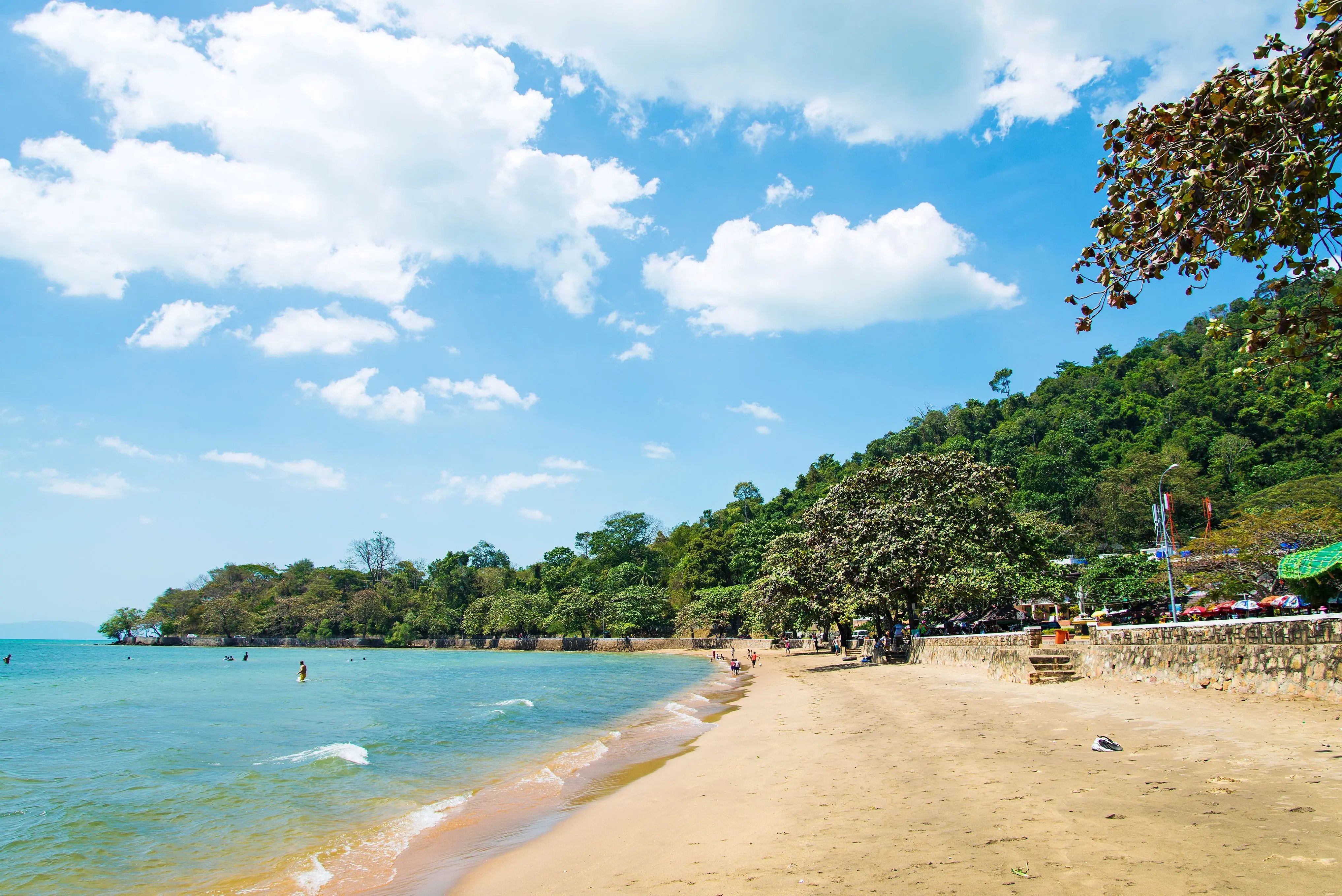
A quiet sandy beach in Kep bordered by lush green hills and calm blue water under a bright tropical sky.
5. Kep: Seafood and Colonial Nostalgia
Just a 30-minute drive from Kampot lies Kep, Cambodia’s smallest province. In the 1960s, this was the "Saint-Tropez of Southeast Asia," where the Khmer elite built modernist villas. Today, it’s a sleepy seaside town famous for one thing: crab.
The Famous Crab Market
The Kep Crab Market is a hive of activity. Watch as women wade into the ocean to pull wooden crab pots from the water. You can buy a kilo of blue manna crab on the spot and take it to one of the adjacent stalls to have it stir-fried with bunches of fresh, green Kampot pepper. It is messy, spicy, and arguably the best meal you will eat in the country.
Kep National Park and Butterfly Trails
Behind the town lies Kep National Park. A well-marked 8km loop trail takes you through lush jungle with various viewpoints overlooking the "Vietnam Canal" and the islands beyond. Keep an eye out for the "Butterfly Garden" near the entrance, where conservationists work to protect the vibrant local species.
A Day Trip to Rabbit Island (Koh Tonsay)
If the islands of Koh Rong feel too far away, Rabbit Island is just a 20-minute boat ride from the Kep pier. There are no cars, no paved roads, and very few tourists. It’s a place to swing in a hammock, eat grilled fish on the sand, and forget that the rest of the world exists for a few hours.
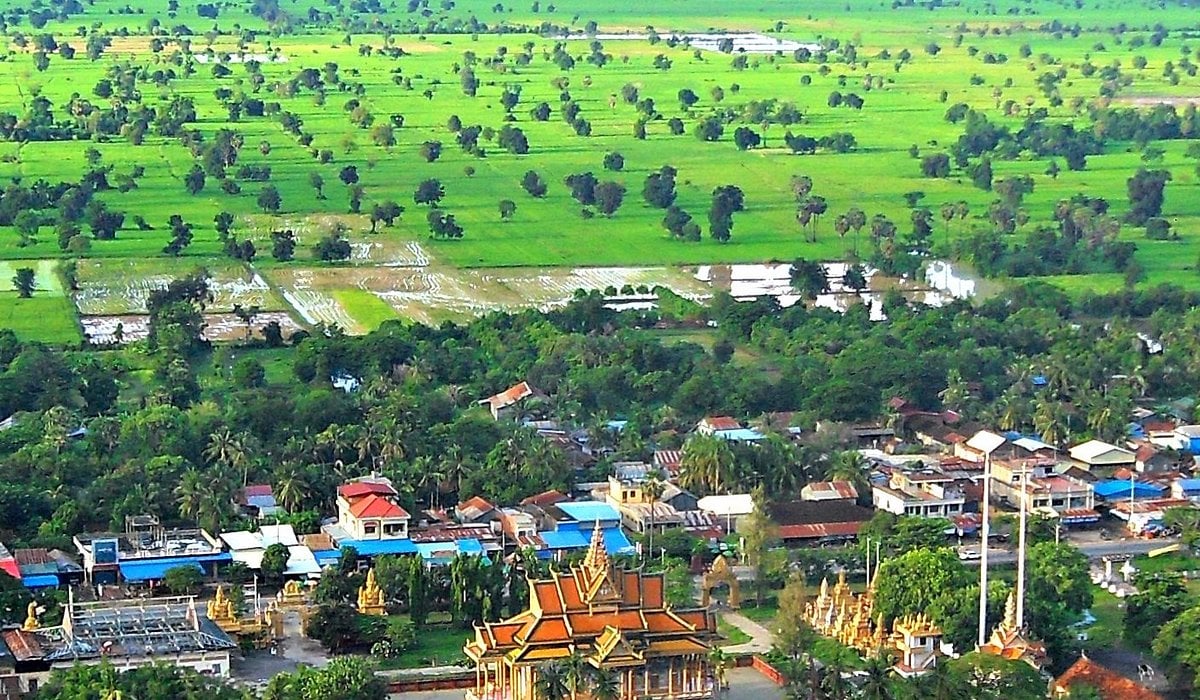
A rural landscape of Battambang with rice fields, village rooftops, and ornate temple buildings spread across the countryside.
6. Battambang: Art, History, and the Bamboo Train
Battambang is Cambodia’s second-largest city, yet it feels like a large village. It is the country’s cultural heart, home to a thriving contemporary art scene and some of the best-preserved colonial architecture outside of Phnom Penh.
Riding the Norry: A Unique Transit Experience
The Bamboo Train (Norry) is a testament to Cambodian ingenuity. When the regular train service stopped running, locals built their own "trains" using wooden slats, bamboo, and small engines. Riding a flat wooden pallet at 30km/h through the rice paddies is a loud, wind-in-your-hair thrill. Note: If you see another "train" coming from the opposite direction, the one with fewer passengers has to dismantle their vehicle to let the other pass!
The Bat Caves of Phnom Sampeau
About 12km from the city lies Phnom Sampeau, a mountain with a complex history. It contains the "Killing Caves" of the Khmer Rouge, now a place of memorial. However, most people gather at the base of the mountain at dusk. Like clockwork, as the sun sets, millions of bats emerge from a cave mouth in a continuous, swirling black ribbon that lasts for over 45 minutes. It is one of nature’s most spectacular daily shows.
Cambodia’s Creative Hub: Art Galleries and Performance
Thanks to the presence of Phare Ponleu Selpak (the arts school that birthed the circus), Battambang is a magnet for painters, musicians, and dancers. Spend an afternoon gallery-hopping along the riverfront. Spaces like Romcheik 5 showcase edgy, provocative contemporary art that proves Cambodia’s creative spirit is very much alive and looking toward the future.
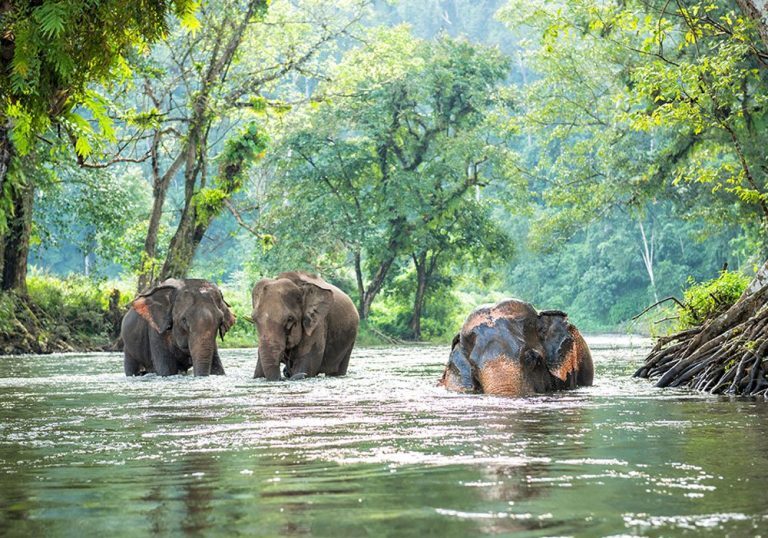
Asian elephants wading through a jungle river in the Cardamom Mountains surrounded by dense green forest.
7. Cardamom Mountains
For the truly adventurous, the Cardamom Mountains near Koh Kong represent one of Southeast Asia's last great wilderness areas. This is not a place for luxury hotels; it is a place for boots, bug spray, and breathtaking biodiversity.
Wildlife and Waterfalls
The range is home to endangered elephants, sun bears, and clouded leopards, while the country's rivers further north near Kratie protect the rare Irrawaddy dolphins. While you’re unlikely to spot a leopard, the sound of the jungle is omnipresent. The region is crisscrossed by hidden waterfalls and river systems that are best explored by boat or on foot with a local guide.
Trekking Through the Eastern Plains & Jungles
Trekking here or visiting the Elephant Valley Project in the highlands of Mondulkiri is challenging but rewarding. You’ll hike through dense rainforest, crossing rivers and staying in basic jungle camps. The reward is total immersion in an ecosystem that feels ancient and untouched. The air is cooler here, and the silence (save for the cicadas) is profound.
Supporting Local Indigenous Communities
Many trekking tours are now run as Community-Based Eco-Tourism (CBET) projects. Places like Chi Phat have transformed from poaching hubs into conservation centers. By visiting, you provide an alternative income for former hunters who now use their expert knowledge of the jungle to guide tourists. It is a powerful example of how tourism can protect the environment rather than degrade it.
Creating Your Itinerary: How Much Time Do You Really Need?
Cambodia may look small on a map, but travel between cities can be slow due to road conditions.
- The 7-Day "Highlights" Trip: Split your time between Siem Reap (4 days) and Phnom Penh (3 days). This covers the must-see history and the urban heart.
- The 14-Day "Classic" Loop: Start in Siem Reap, head to Battambang, then down to Phnom Penh, and end with some relaxation in Kampot or the islands.
- The 21-Day "Deep Dive": Add the Cardamom Mountains for trekking and the remote temples of the north (Preah Vihear) to the classic loop.
Regardless of your timeframe, the golden rule of Cambodia travel is "Slow Down." Heat and humidity will drain your energy faster than you expect. Build in "buffer time" to simply sit in a café and watch the world go by.
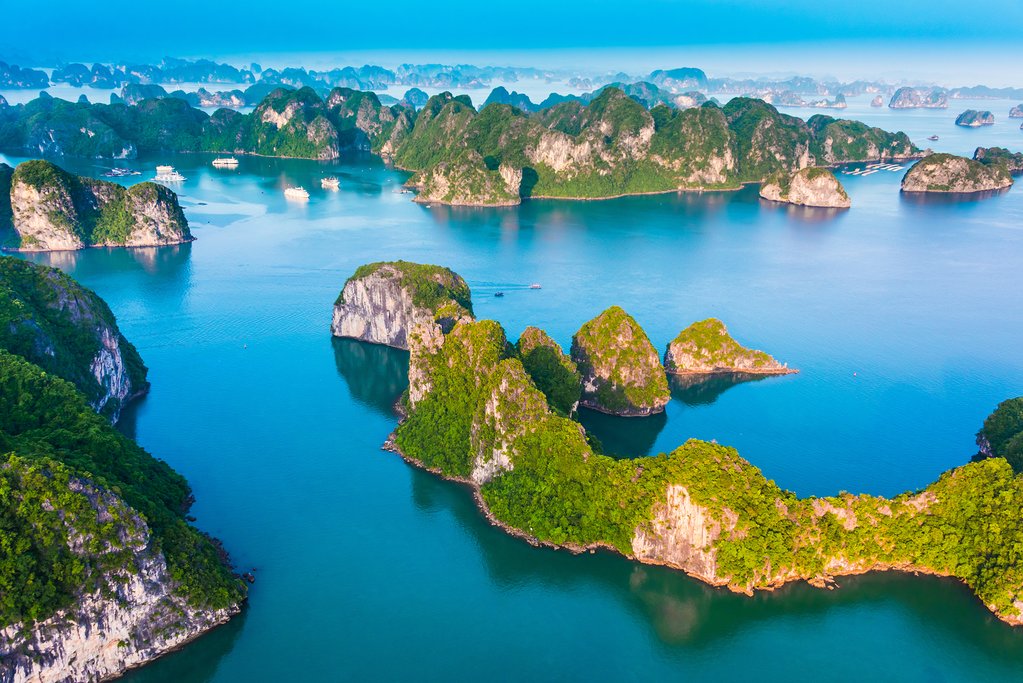
Limestone islands rising from vivid blue water with boats scattered among the karst formations.
Cultural Etiquette and Responsible Tourism
Cambodia is a deeply conservative and polite society. A little bit of cultural awareness goes a long way in earning the respect of your hosts.
Respecting the Monks and Local Customs
You will see monks in their saffron robes everywhere. They are highly respected members of society. Women should never touch a monk or hand them something directly. If you wish to take a photo, always ask for permission first with a small nod or a Sampeah (the traditional Cambodian greeting where you press your palms together).
Final Thoughts on the Wonders of the Khmer Empire
Cambodia is a country that stays with you. Long after you’ve returned home, you’ll find yourself thinking of the way the light filtered through the trees at Ta Prohm, or the specific, spicy-sweet smell of a Khmer curry.
It is a place that challenges your perceptions of tragedy and triumph. You go for the ancient temples and stones of Angkor, but you come back because of the soul of the people. So, pack your bags with an open mind and a respectful heart. The Kingdom of Wonder is waiting to show you exactly why it deserves its name. Safe travels, or as they say in Khmer: Sok Sabay!
Ready to Experience Cambodia?
Whether you're dreaming of Angkor Wat, floating villages, jungle adventures, or relaxing on a private island, Global Basecamps offers a variety of journeys designed to showcase the very best of Cambodia.
👉 Explore Cambodia with Global Basecamps